Julia
Under Your Spell: A Romance Boxed Set of Masked Balls, Haunted Gardens, Magic, and MoreJulia is a history student whose fascination with Willingdon Manor transforms an apparently accidental Halloween invitation into the decisive encounter of her life. She first saw the manor from an impossible vantage point while hiking, could never find it again, and eventually chose her field of study partly because the house had captivated her so completely. At the Halloween party, her practical knowledge saves the celebration after the power fails, while a kiss with Jason triggers a vision that confirms the manor’s supernatural hold over her. By the end of the episode, Julia learns that Paul dreamed about her on the same day she first saw the house, binding her personal longing to the manor’s prophetic mystery and opening the possibility of a new relationship.
Identity and Background
Julia is closely associated with history, landscape, and the preservation of the past. She studied history at Boston University and had secured her dream summer job as a historical interpreter at a pioneer village upstate. Her interest in the past is not merely academic: she had been haunted for two years by the image of Willingdon Manor, a great stone house glimpsed only once while hiking and then apparently lost from the landscape. She tells Paul that the house seemed to speak to her, an admission she expects to sound irrational but that he immediately treats as meaningful rather than absurd. That response helps establish that Julia’s sensitivity to the manor is not simple romantic fantasy.
Her ordinary intellectual identity gives her an interpretive framework for the house, but the house repeatedly exceeds what historical knowledge alone can explain. Julia’s connection to Carly also anchors her in a recognizable social world. Carly has been her best friend since high school, when Carly’s family moved to the area, and Julia has visited her house ever since. Carly’s call about the exclusive party at Willingdon Manor gives Julia the chance to return to the place that has shaped her imagination. Julia abandons plans to go to the Tap Room with Viv and Nicoletta, and Carly jokes that the invitation has also rescued her from wearing the same sexy librarian costume for a third year.
The comic detail places Julia’s extraordinary destiny against the continuity of ordinary friendship and seasonal ritual.
The Longing for Jason
Before the manor’s deeper mystery emerges, Julia’s emotional life is organized around Jason, a college crush she has carried since the first time she saw him in September of her senior year. She was waitressing part-time at The Red Lion while studying at Boston University when Jason entered the pub. His appearance left her suddenly breathless, and his presence made her so nervous that she became nearly speechless whenever she approached his table. For the next eight months, Jason returned regularly with his friends, allowing Julia to collect fragments of his life from a safe distance. She learned that he was several years older, was doing graduate work at MIT, specialized in cyber security, was friendly without being flirtatious, and never drank more than two pints a night.
Her attraction therefore grows through observation and deferred contact rather than through an established relationship. Julia eventually stopped taking shifts at The Red Lion to concentrate on final examinations, then worried that she had lost her chance to speak to Jason before leaving for her summer job. On the night of her last exam, however, colleagues persuaded her to attend farewell drinks at The Red Lion. The crowded pub, the raucous Celtic band, and Jason’s drunkenly dishevelled appearance reverse the earlier distance between them. He recognized Julia, invited her to drink with him, and suggested that they could finally spend time together. Jason took her hand to the bar; amid the pounding music and the press of the crowd, he pulled her close by hooking a finger into the front pocket of her jeans and kissed her.
The kiss fulfills a desire Julia had carried since their first meeting, but it is interrupted when someone crashes into them. The interruption preserves the pattern of incompletion that has defined her longing: the desired moment arrives, yet it cannot settle into certainty. Six months later, the memory remains physically immediate. Julia can still hear the music, feel Jason drawing her closer, and see him bend toward her. When Carly asks whether Jason will attend the manor party, Julia’s imagination returns instantly to his jaw, chestnut hair, and soft lips. Her anticipation of seeing him again is therefore both romantic and haunted by the earlier encounter’s unfinished quality.
Arrival at Willingdon Manor
A severe Halloween storm accompanies Julia’s return to the manor. Rain intensifies throughout the afternoon, the wind rises, clouds darken, and by four o’clock the roads are inundated while sudden gusts batter her car. Reaching Carly’s driveway is a relief, and the familiar route emphasizes how unusual the weather has become. Julia and Carly then locate the concealed entrance: pine trees and overgrown holly bushes hide the open wrought-iron gate, which Julia nearly drives past. Carly recalls that the first sight of Willingdon Manor changed Julia’s life, and Julia acknowledges that she could not forget it. The threshold produces an immediate transformation.
Once the car passes through the gate, the black asphalt becomes grey gravel, the forest recedes, the rain stops, and the sky brightens. A warm breeze enters the car, followed by a soft whisper. The manor thus behaves less like a fixed building than a boundary crossing between ordinary geography and an enchanted domain. Julia’s prior sighting is recalled as a perfect Sunday morning during her first year waitressing at Pinehurst Lodge. Usually she and her friends hiked together and stayed on marked trails, but that day she went out alone and somehow wandered off course. At the crest of a hill, she saw the stately stone building across the valley like an apparition.
The event gave the house an aura of singularity: it was visible to her, yet not available to ordinary searching. Her return with Carly converts that solitary vision into a shared physical arrival, though the manor remains selective in what it reveals.
The Power Outage and Julia’s Practical Authority
The party is threatened when the manor loses electric power, leaving the guests literally in the dark while the storm continues outside. Julia refuses to treat the outage as a reason for immediate failure. She recalls candles in the next room and oil lamps downstairs, reasoning that old houses are likely to contain more of them. She also points out that fires are already burning in every room, which will keep everyone warm and create an atmosphere appropriate to Halloween. Her solution is not based on supernatural knowledge but on historical imagination: she understands the building as a pre-electrical environment and can therefore recover resources that others overlook. When Paul remains uncertain, Julia reframes the emergency as very fancy camping.
She proposes that, at worst, the guests can drink neat Scotch and roast marshmallows until the electricity returns. Paul’s mood changes as her confidence becomes contagious; he smiles, claps his hands, and agrees to try. When Carly asks what they should do first, Julia answers firmly that they need light. This sequence establishes Julia as more than the woman awaiting a romantic or prophetic revelation. She acts, interprets, organizes, and restores communal possibility. Her intervention saves a party that the company has arranged to celebrate a major global contract, and Paul later explicitly credits her with making the event possible.
The Manor, Jason, and the Prophetic Connection
Julia’s renewed contact with Jason eventually takes place in the manor’s conservatory, where tea lights illuminate antique tiles, a marble pool, a bronze cherub fountain, and dense greenery behind rain-streaked glass. The conservatory’s artificial warmth and romantic beauty create the conditions for Julia to act rather than wait. Jason, wearing a scarlet-feathered eye mask, does not notice her until she is almost beside him. Julia sits next to him, takes his face in her hands, and pulls him into a kiss. This time she initiates the encounter, reversing the earlier scene at The Red Lion in which Jason drew her toward him. The kiss immediately produces a rupture in ordinary perception. The rain disappears, the bench vanishes, and Julia finds herself on a rough rock under warm, dry air scented with summer grass.
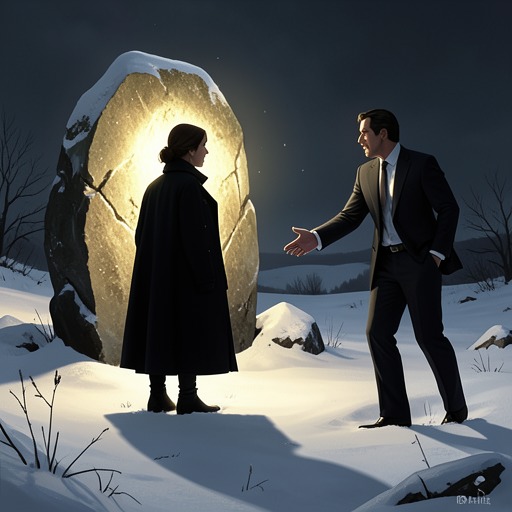
Across an emerald-green valley stands Willingdon Manor—the same house she saw during her solitary hike. She returns to the conservatory with Jason’s arms around her, but the vision has altered the meaning of the kiss. The experience gives bodily force to the knowledge that he is the one, yet it also shifts the supernatural center of Julia’s story away from Jason and toward the manor’s larger pattern. Paul later explains that he dreamed about Julia on the same day she saw the house. He points to a painting of the manor and states that no trail leads to that view: a hundred-foot rock face and forest should make it inaccessible. Julia’s vision was therefore not a misremembered hike but an event that corresponds to Paul’s prophetic experience.
The revelation joins Julia’s private memory to a family tradition. Paul recounts that Lord Willingdon Senior once dreamed vividly of the woman he believed would become his future wife, dismissed the dream as a trick of the subconscious, and married according to his parents’ arrangement. Three years later, he met the woman from the dream. Julia’s question about whether Paul dreamed of her exposes the emotional and metaphysical stakes of their encounter. Paul confirms it carefully, saying he does not want to frighten her, but the evidence leaves the connection difficult to dismiss. The manor’s impossible geography, Julia’s vision, Paul’s dream, and the older Willingdon precedent form a pattern in which desire is not simply chosen but recognized across time.
Change, Relationships, and Narrative Role
Julia begins this sequence looking backward: toward Jason’s interrupted kiss, toward the single vanished sight of the manor, and toward the academic path shaped by that memory. Her movement through the plot is a gradual transfer from passive anticipation to active participation. She accepts Carly’s invitation despite giving up familiar Halloween plans, drives through the storm, crosses the manor’s hidden threshold, keeps the party alive during the outage, and finally initiates the kiss that opens the vision. Each action makes her less a spectator of the house’s mystery and more an agent within it. Her relationship with Jason remains important because it supplies the emotional expectation against which the manor’s revelation is measured.
Julia thinks she is returning to a long-desired college crush, and the conservatory kiss appears to reward that desire. Yet the vision of the manor and Paul’s dream redirect the narrative toward a different form of recognition. Jason represents the romance Julia has consciously rehearsed for months; Paul and the manor represent a connection whose meaning precedes conscious explanation. The contrast does not erase Julia’s attraction to Jason, but it makes her former longing part of a larger structure of expectation, interruption, and discovery. At the close of the episode, Paul does not demand an immediate declaration. He first insists that the party must be finished, since Julia’s intervention made it possible, and then offers to pour her wine after the guests leave and sit with her by the library fire while hearing everything about her.
Julia’s joking claim that she is a regular superwoman is met by Paul’s earnest affirmation. The exchange gives her practical achievement and emotional significance equal weight. Julia’s ending is consequently not a completed romantic resolution but a promise of chosen intimacy after the public crisis has passed: the woman who once watched Jason from a safe distance now stands at the center of a house that seems to have been waiting for her.